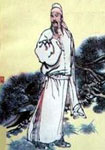
Wang Zhihuan | sekrup kaca cermin, balques manisang kristen
Introduction
Wang Zhihuan was a famous poet during the Tang Dynasty. He was well-known for his classic poem "Ascend the Stork Tower" and became a household name.
There is not much information about Wang Zhihuan's life. We only know that he moved from Bingzhou to Jiangzhou (today's Xinjiang County, Shanxi) in his early years and served as the chief bookkeeper of Hengshui in Jizhou. Li Di, the magistrate of Hengshui County, betrothed his third daughter to him. Because he was slandered by others, he dismissed his official position, "then he traveled to Qingshan and broke the yellow ribbon. He was thousands of miles away from the river, taking advantage of its high winds; he stayed at home for fifteen years and lived with his old virtues. He talked elegantly about Guijue and was fond of leisure." He later returned to serve as Wen'an County Captain and died during his tenure.
Wang Zhihuan was "generous and broad-minded, suave and talented". He was proficient in articles in his early years and was good at writing poems. Most of them were quoted as lyrics. He often sang harmony with poets such as Wang Changling and Gao Shi, and he became famous for a while. He is especially good at five-character poems and is particularly good at describing the scenery of frontier fortresses. He is a romantic poet. Jin Neng's "Epitaph of Wang Zhihuan" said that his poems "taste or sing about joining the army, chanting out of the fortress, and thinking about the bright moon in the mountains at the end of the mountain. The sound of the cold wind in the Yi River spreads to the music and spreads among the people." However, there are only six quatrains of his works in existence, including three frontier fortress poems. His poems are represented by "Climbing the Stork Tower" and "Liangzhou Ci". Zhang Taiyan recommended "Liangzhou Ci" as "the best of quatrains": "Far above the Yellow River, among the white clouds, there is an isolated city called Wanren Mountain. Why should the Qiang flute blame the willows? The spring breeze does not pass through Yumen Pass."
< /p>
Life of the character
Mystery of life experience
There is no biography of Wang Zhihuan in the old and new "Book of Tang", and the "Biography of Talented Scholars of the Tang Dynasty" is also very brief, saying that Wang Zhihuan was from Jimen. Jin Neng of the Tang Dynasty wrote the "Preface to the Epitaph of the Prince of Taiyuan in Wen'an County, Wen'an County in the Tang Dynasty". It is recorded that Huan "originated in Jinyang and moved to Jiangjun as an official", so Jinyang (today's Taiyuan) was his original place. When he was an official, he lived in Jiangzhou (today's Xinjiang County, Shanxi Province). The epitaph says that Wang Zhihuan died in February of the first year of Tianbao (742) at the age of 55. It can be seen that he was born in the fourth year of Chui Gong of Empress Wu (688).
Official disobedience
In the fourth year of Empress Wu’s reign (688), Wang Zhihuan was born into the Wang family in Taiyuan, a prominent family at that time. His fifth generation ancestor Wang Longzhi was the governor of Jiangzhou in the later Wei Dynasty, and he may have moved to Jiangzhou because of this. Great-grandfather Wang Xin was a doctor and author in the Sui Dynasty, and became the magistrate of Anyi in the Tang Dynasty.
In the 14th year of Emperor Xuanzong's reign (726), Wang Zhihuan was appointed as the chief clerk of Hengshui, Jizhou, and wrote "Fanyan Ci" and "Farewell".
In the tenth year of Kaiyuan (722), Wang Zhihuan married Bohai Li, the third daughter of Li Di, the magistrate of Hengshan County in Jizhou.
In the fourteenth year of Kaiyuan (726), Wang Zhihuan resigned from his official post because he was framed and slandered.
Singing Harmony at Home
From the fifteenth year of Kaiyuan (727) to the twenty-ninth year of Kaiyuan (741), Wang Zhihuan lived at home for fifteen years. He wrote two poems: "Nine Days Farewell", "Climbing the Stork Tower" and "Liangzhou Ci".
In the 20th year of Kaiyuan (732), Wang Zhihuan lived in Jimen. Gao Shi did not see him when he came to visit, so he wrote poems and left them as gifts.
He died of illness
In the first year of Tianbao (742), Wang Zhihuan was promoted to Wen'an County Lieutenant in Wen'an County. On February 24 of the same year, he died of illness and died at the age of fifty-five.
In the second year of Tianbao (743), Wang Zhihuan was buried in Beiyuan, Luoyang, and Wei Jinneng of Yongning County wrote the epitaph.
Reference materials:
1. Li Ximi. An examination of the family history and deeds of Wang Zhihuan, a poet in the prosperous Tang Dynasty [J]. Jinyang Academic Journal, 1988(3):97-103
Cemetery
We learned from Luoyang Qiantang Zhizhai Museum that recently, the museum has collected the epitaphs of Wang Zhihuan’s cousin Wang Zhixian and Wang Zhixian’s fifth son Wang Wan. According to the person in charge of the museum, so far, nine epitaphs of the Wang family including Wang Debiao and his wife, Wang Luoke, Wang Zhixian, Wang Wan, and Wang Zhihuan have been unearthed in Luoyang, which is enough to show that the cemetery of the famous Tang Dynasty poet Wang Zhihuan's family is in Luoyang.
Wang Zhixian’s epitaph records that his grandfather’s name was Wang Debiao, who once served as the magistrate of Wen’an County in Yingzhou; his father’s name was Wang Jing, who had served as governor of Dengzhou and Laizhou; Wang Zhixian once served as a captain of Chang’an County, but was later demoted to the position of a magistrate of Zichuan County for some reason. On April 12, the tenth year of Tianbao in the Tang Dynasty (AD 751), 57-year-old Wang Zhixian died of illness in his official residence in Zichuan. On October 17, the twelfth year of Tianbao, he and his wife Li were buried together in Beimang Mountain, Luoyang.
Wang Wan’s epitaph records that Wang Wan held ten official positions in his life, and was finally awarded the position of Doctor Zuo Zanshan. In 793 AD, Wang Wan died in Chang'an, the capital. Wang Wan's second brother was serving as Yushi Zhongcheng in the south of the Yangtze River at the time. After hearing the news, he asked his son to rush to Chang'an and escort Wang Wan's coffin back to Luoyang, where he was buried in the ancestral tomb of Beimang Mountain on April 7 of the following year.
According to Zhao Genxi, a researcher at the Qiantang Zhizhai Museum, Zhiwen records that Wang Zhihuan’s family was originally from Taiyuan, Shanxi. The first person buried in Luoyang after his death was Wang Zhihuan’s grandfather, Wang Debiao. Wang Debiao lived in Luoyang in his later years. He had five sons in total, one of whom was named unknown, and the other four sons were named Wang Yu, Wang Luoke, Wang Jing and Wang Chang. They were all buried in Luoyang after their deaths. Wang Zhihuan is Wang Yu's son. Currently, the Qiantang Zhizhai Museum collects seven epitaphs of the Wang family. Wang Luoke’s epitaph is now in the Art Museum of the Chinese University of Hong Kong; Wang Zhihuan’s epitaph was unearthed in the 1930s and is now in the Nanjing Museum.